The Salmonidae family, commonly referred to as salmonids, encompasses a diverse group of 45 species including salmon, trout, chars, and whitefish native to North America.
Within this family, the genera Salmo, Salvelinus, and Oncorhynchus feature many trout species that are highly valued by anglers from around the globe.
For anglers, accurately identifying their catch is crucial. This guide serves as a practical tool for recognizing the most frequently pursued trout species.
Key identification features include body coloration, fin characteristics, and the presence of spots or patterns on various parts of the fish, all of which contribute to determining species.
Brown Trout (Salmo trutta)
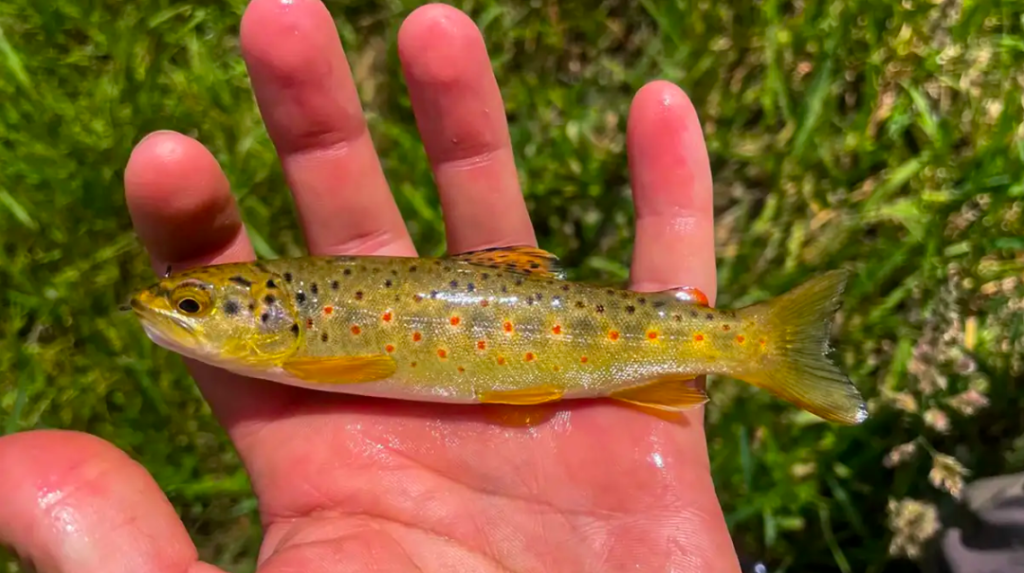
Brown trout exhibit a coloration ranging from brown to yellow-brown, featuring vibrant orange shades during the breeding season.
Their bodies are adorned with black spots bordered with lighter edges and red spots highlighted with white margins.
The adipose fin displays a red edge with additional spots. Fins such as the anal, pelvic, and pectoral have hues of orange to yellow, while the tail typically shows few or no spots. They can develop a bluish tint on the gill plates.
Brook Trout (Salvelinus fontinalis)
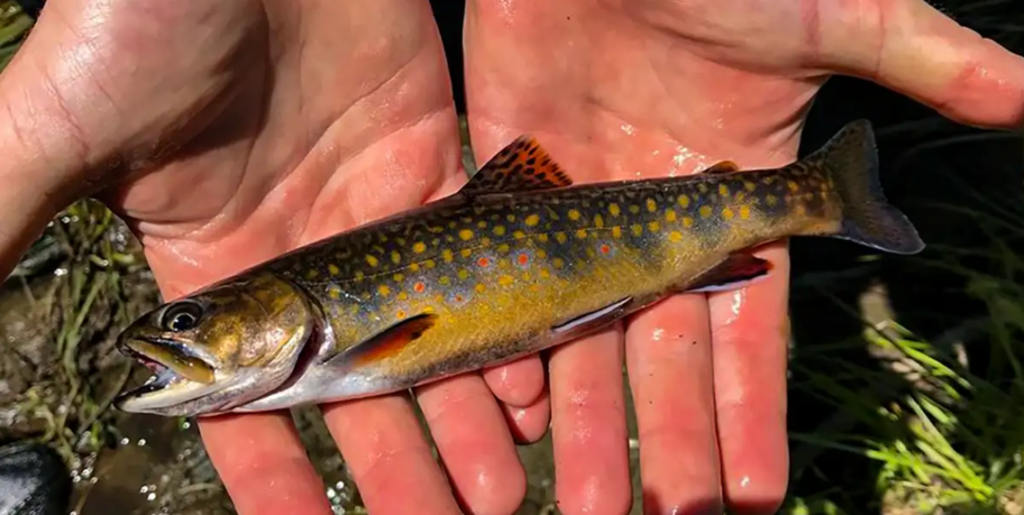
Brook trout exhibit a dark green coloration on their back, adorned with elongated blotches. Their sides feature vivid yellow and red spots, each surrounded by a blue halo.
The coloration transitions from green to a striking yellow or red in the lower section, especially vibrant during the spawning period. The silvery-white belly contrasts with the red anal, pelvic, and pectoral fins that have white edges.
The anal fin contains 9 to 13 rays, while the tail showcases elongated blotches and a slightly forked appearance.
Rainbow Trout (Oncorhynchus mykiss)
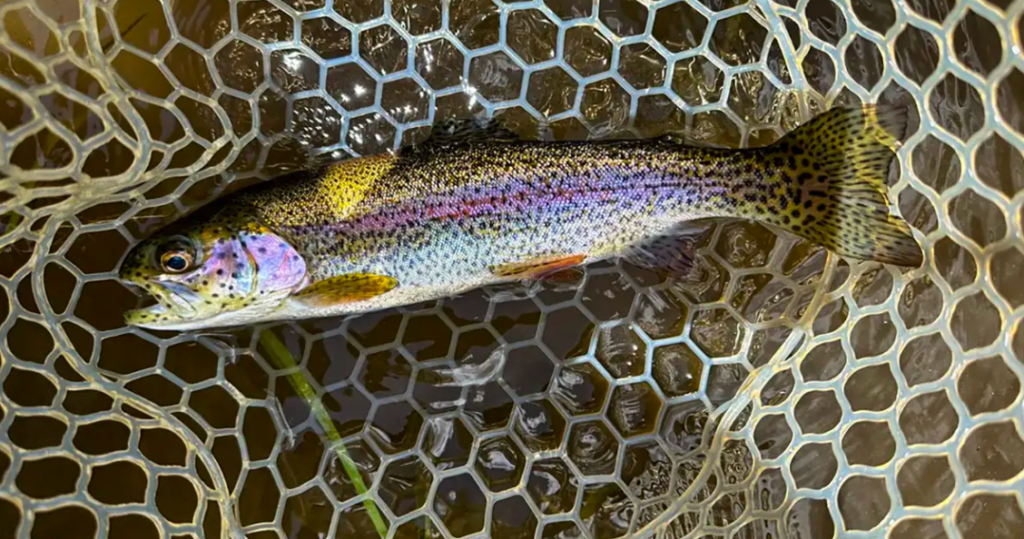
Rainbow trout exhibit an olive green back that transitions into a silvery green along the sides. They are characterized by black spots across the sides, back, and top fins, with additional spots visible on the caudal fin.
A reddish-pink hue may be noted along the sides and gill plates, while the belly appears silvery white. Notable features include:
- 10-12 anal fin rays
- Slightly forked caudal fin
Cutthroat Trout
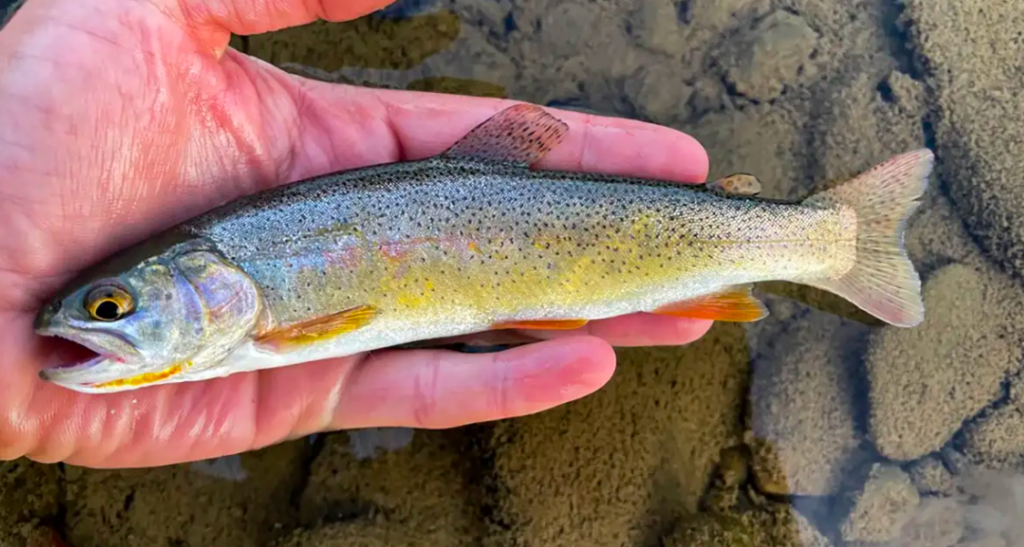
Cutthroat trout belong to four distinct species: Coastal Cutthroat, Lahontan Cutthroat, Westslope Cutthroat, and Rocky Mountain Cutthroat. Key characteristics include:
- Greenish back transitioning to a silvery-green side
- Black spots predominantly located on the posterior half of the body
- Distinct orange marking beneath the lower jaw
- Potential for yellow-orange shading on anal, pelvic, and pectoral fins
- 8 to 12 rays on the anal fin
- A slightly forked tail with various colors and black spots.
Lake Trout (Salvelinus namaycush)
Lake trout have a body that ranges from dark brown to a silvery green hue, adorned with cream-colored spots. Their fins are a lighter brown, exhibiting a subtle white edge, and they feature a deeply forked tail with 8-12 anal fin rays.
Golden Trout (Oncorhynchus aguabonita)
The Golden Trout displays a striking golden-yellow hue complemented by a subtle greenish back. Black spots adorn the upper body, while the dorsal and caudal fins also feature spots.
Notably, its lateral line has approximately ten parr marks, alongside a distinctive reddish-pink stripe, and the orangish anal, pelvic, and pectoral fins have white and black tips, with 11 to 12 anal fin rays.
Bull Trout (Salvelinus confluentus)
Bull trout present a darker greenish-grey coloration on their bodies, transitioning to a lighter shade on the belly. They are adorned with light to orange spots, while their dorsal and caudal fins remain unmarked, displaying dark hues. Their pelvic, pectoral, and anal fins are lighter with white edges, featuring 8 to 11 anal fin rays.
Tiger Trout (Salmo trutta × Salvelinus fontinalis)
The tiger trout is a hybrid originating from the mating of brook trout and brown trout. It exhibits a color palette that includes shades from yellow-brown to a rich deep orange, featuring distinctive wavy tiger-like patterns and blotches.
Notable characteristics include markings on the caudal fin and pale white edges lining the pelvic and anal fins, with 9 to 13 rays present on the anal fin.
Spotted Seatrout (Cynoscion nebulosus)
Additional Information
The Spotted Seatrout belongs to the Sciaenidae family rather than the Salmonidae. It typically displays a dark gray to greenish back with a contrasting white belly. Characteristic dark circular spots, adorned with white borders, can be found along its body.
Notably, it features a set of canine-like teeth in its upper jaw. Instead of an adipose fin, it has a second dorsal fin and a squared caudal fin accented with a black margin. The jaw line extends to the rear edge of its eye, a distinctive trait of this species.
- Typical Features:
- Coloration: Dark gray-green on top; white underneath
- Spots: Dark spots with white edges
- Teeth: Canine teeth on upper jaw
- Fins: Second dorsal fin instead of adipose fin; square caudal fin